One photograph, a priced Square order on the terminal. Sunoa's camera register reads the whole tray.
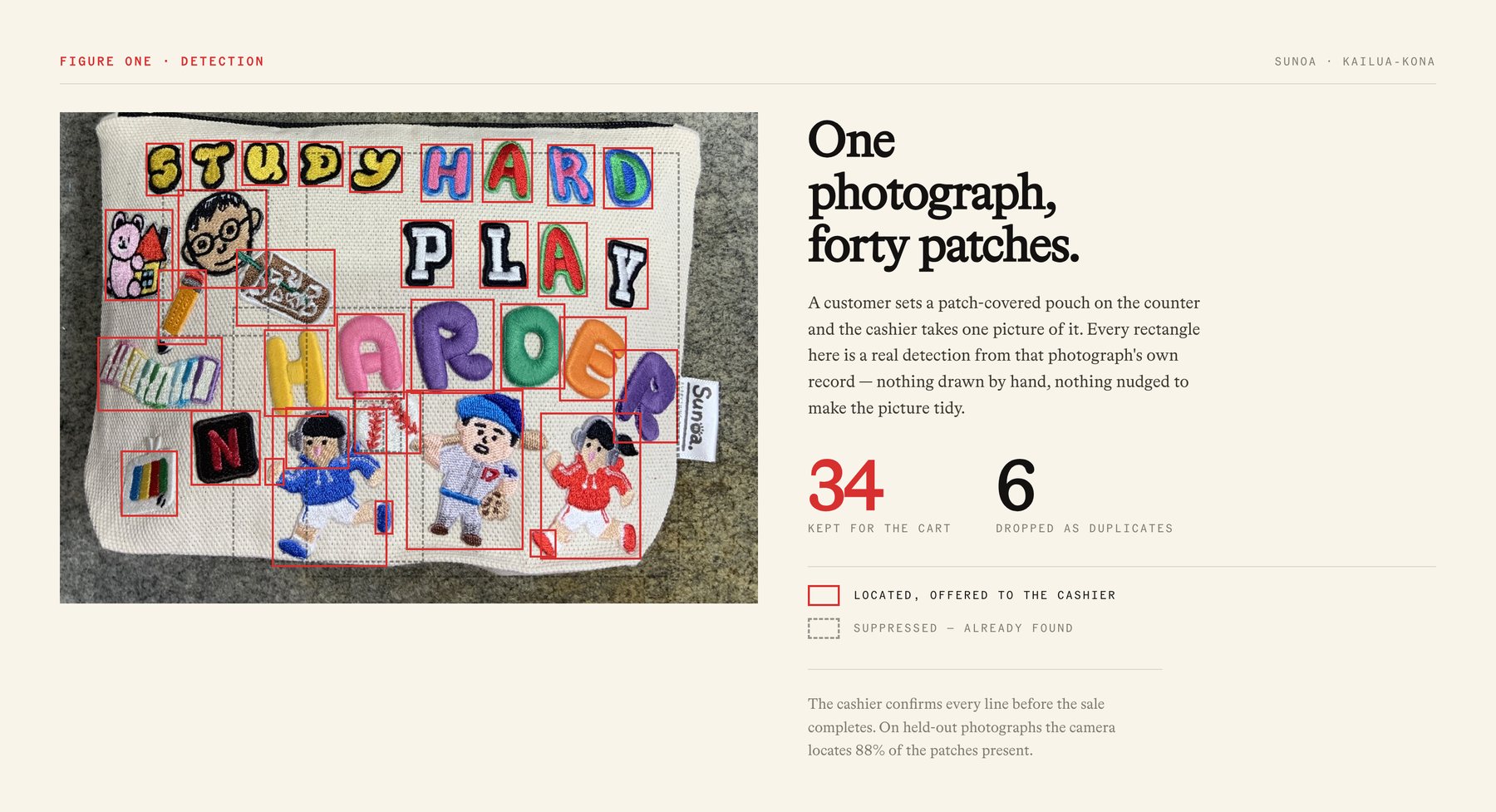
A staff member photographs the tray. The register finds the patches, prices them from Sunoa's own Square catalog, and holds every row for a human to confirm before the sale closes.
Client background
Sunoa is a Kailua-Kona patch shop selling hundreds of small embroidered SKUs, most of a customer's purchase arriving at the counter as a tray of them at once.
Business challenge
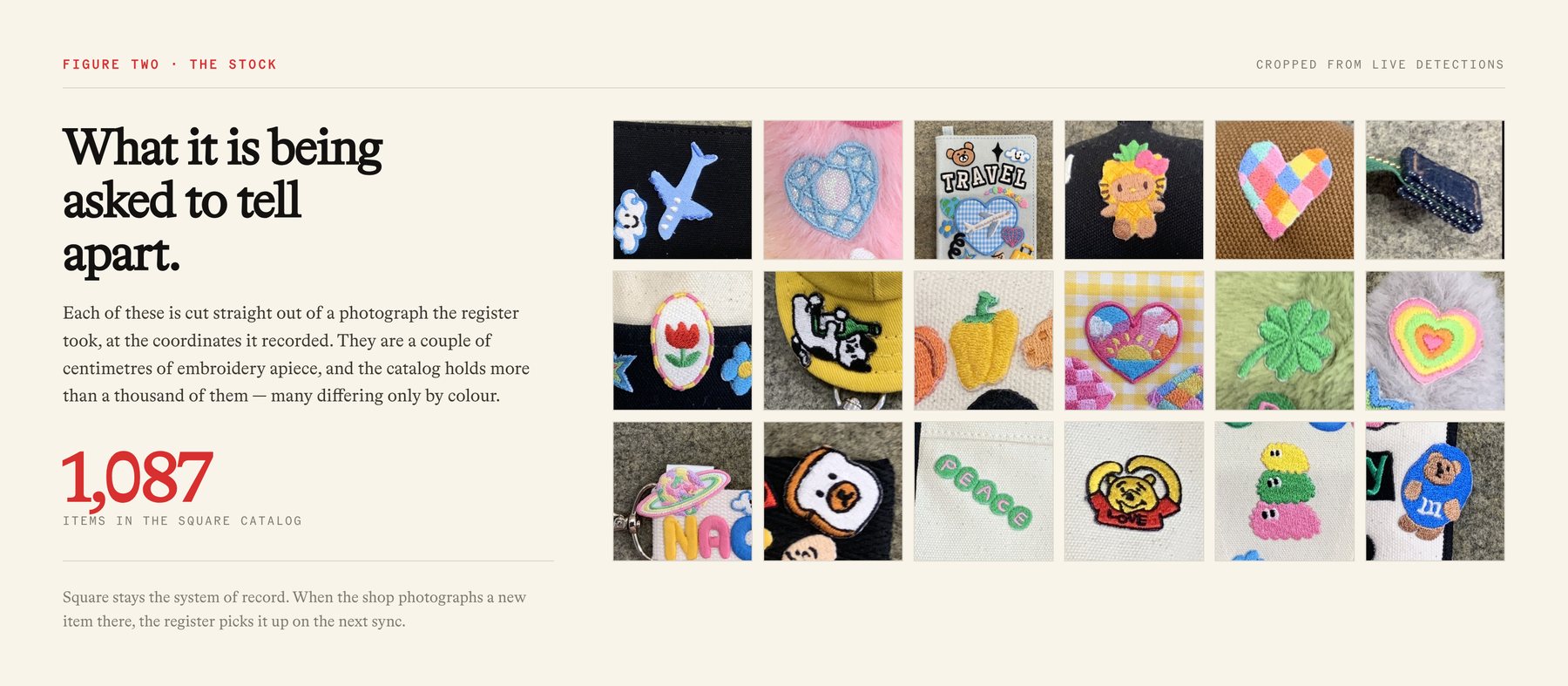
A shop like this rings up dozens of small, similar items in a single transaction. Doing it one at a time is the slowest part of the sale, and the customer is standing right there watching it happen.
Vision systems are the obvious answer and the obvious risk. A model that quietly mis-identifies a patch does not fail loudly, it undercharges, and a shop cannot run a till on a number nobody has verified.
Delivering the solution
The cashier photographs the tray on an iPad and the cart fills itself from the shop's own Square catalog, quantities editable, every row confirmed before the sale completes. That confirmation step is permanent by design rather than scaffolding waiting to be pulled out once the model is good enough, because of what the failure looks like when it is wrong.
What sits underneath is a full register built on Square rather than a scanner bolted beside one. Prices and tax come live from Square at the moment of sale, the order is created in the shop's existing Square catalog and pushed to the paired Square Terminal for the tap, and cash tender, refunds, discounts and recovery of an abandoned checkout all run through the same account. Nothing about how the shop takes money had to change.
The detail worth copying is that Square stays the single source of truth. When the owner updates an item's photo in Square, the iPad notices and refreshes its own reference for that item on the next sync. Ordinary housekeeping in a dashboard the shop already uses keeps the camera current, with no retraining ceremony and nobody from our side in the loop.
And the system learns at the counter. A correction becomes a new reference, a deleted row teaches it to stop offering that look-alike again, and both travel between devices, so the register gets better at this shop's inventory through being used rather than through us shipping a build.
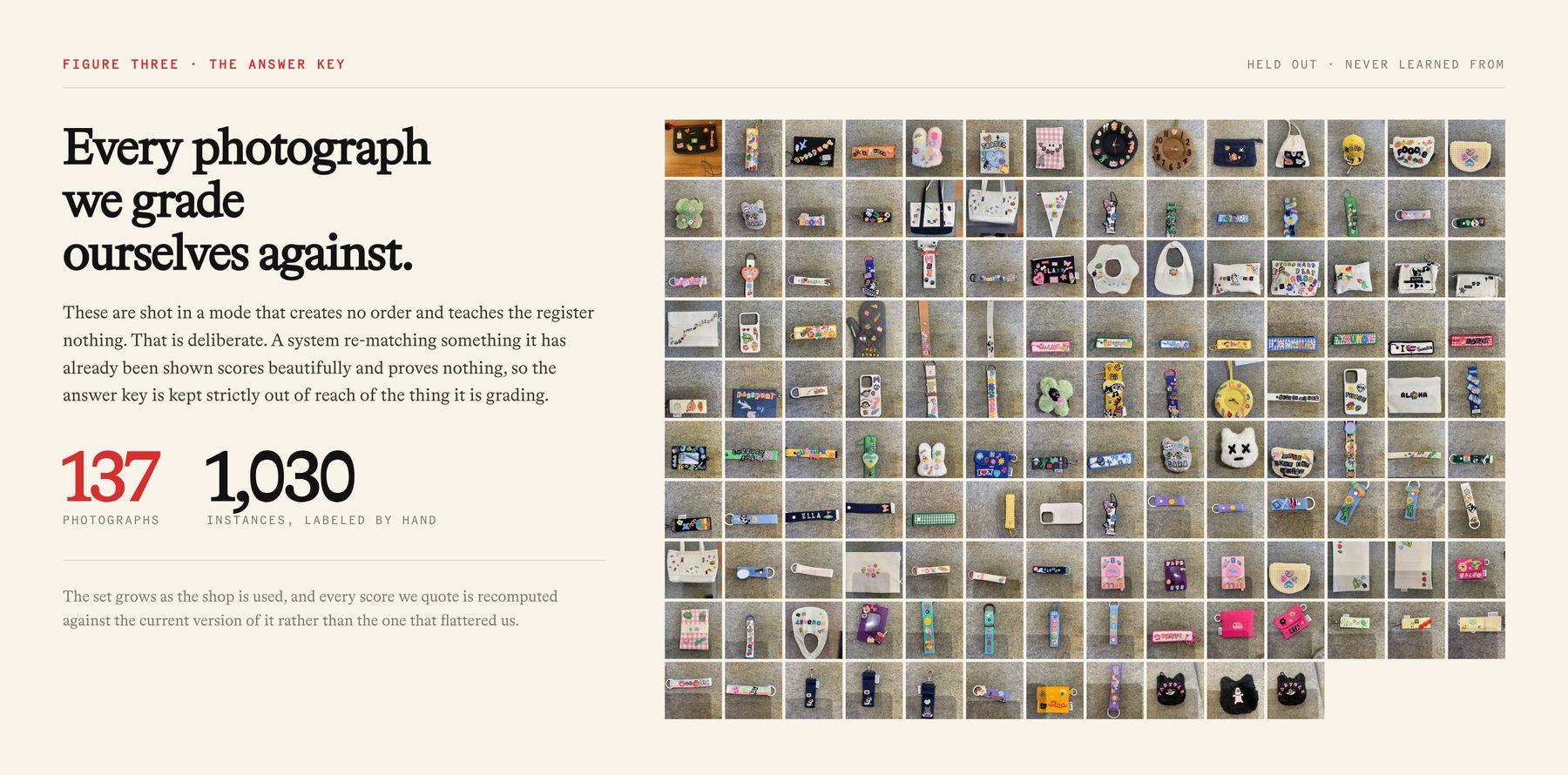
The part we are most willing to be judged on is the measurement. Benchmark photos are shot in a mode that creates no order and learns nothing, deliberately, because a system re-matching something it has already memorised would score beautifully and mean nothing. The answer key is hand-verified, it has grown to 1,030 labeled instances across 137 photographs, and the score moves as it grows.
Results
A photographed tray comes back identified in about 250 milliseconds, so the cart is populated before the customer has finished setting it down. Scanning is no longer the part of the sale anyone waits on.
The larger saving is weekly rather than per-transaction, and it comes from what the counter no longer has to know. Ringing up a tray used to depend on recognizing hundreds of near-identical patches from memory, which is what made the job slow to learn and slow to do quickly. The shop puts the time it gets back at hours a week.
Built in 8 weeks, with the iPad app a further five days.
Sunoa Deploys Camera Point-of-Sale Built on Square
One photograph fills the cart from the shop's Square catalog and lands a priced order on the Square Terminal, with every line confirmed at the counter. Built by Internal Automation.
KAILUA-KONA, HI · July 31, 2026 · Sunoa, a Kailua-Kona patch shop, has deployed a camera-based point-of-sale system built by Internal Automation. It runs on an iPad and settles on the shop's paired Square Terminal.
A staff member photographs the customer's tray and the system fills the cart from the shop's existing Square catalog. Quantities remain editable, and every row is confirmed by staff before the sale completes.
The system operates as a complete register on Square rather than a scanner attached to one. Prices and tax are retrieved live from Square at the time of sale, the order is created within the shop's existing Square catalog and sent to the paired Square Terminal for payment, and cash tender, refunds, Square-defined discounts, and recovery of an interrupted checkout are handled through the same account.
Square remains the system of record for items and pricing. When the shop updates an item's photograph in Square, the iPad refreshes its own visual reference for that item on the next sync, so routine catalog maintenance in Square keeps the camera current with no separate retraining step.
The system continues operating during a network interruption. A sale can be rung, taken and closed while the connection is down, and the shop's records reconcile once it returns.
Performance is measured against a hand-verified ground truth, currently 1,030 labeled instances across 137 photographs. The system locates 88% of patches present in a photograph. Item identification is confirmed by staff at the counter before the sale completes. Benchmark photographs are captured in a mode that creates no order and contributes no learning, so the measurement cannot be inflated by the system re-matching images it has already been taught.
Sunoa owns the system, the Square integration, and the evaluation data.
###
About Internal Automation
Internal Automation designs, builds, and maintains custom AI workflows, agents, chatbots, reporting systems, and integrations for enterprises. Engagements are fixed price and fixed timeline, agreed before the build begins, and every system is owned by the client with no vendor lock-in.
Media contact
Press inquiries go through https://internalautomation.com/contact. We reply within one business day.
More from the newsroom
Aloha Vibes Bar & Grill reservations and operationsHospital Supply HQ medical wholesale ordering engineUpBuoy pool-service field operations platform